October 08, 2026
The Beginner’s Guide to Quartz Crystal Types: Clear, Rose, Smoky, and Amethyst
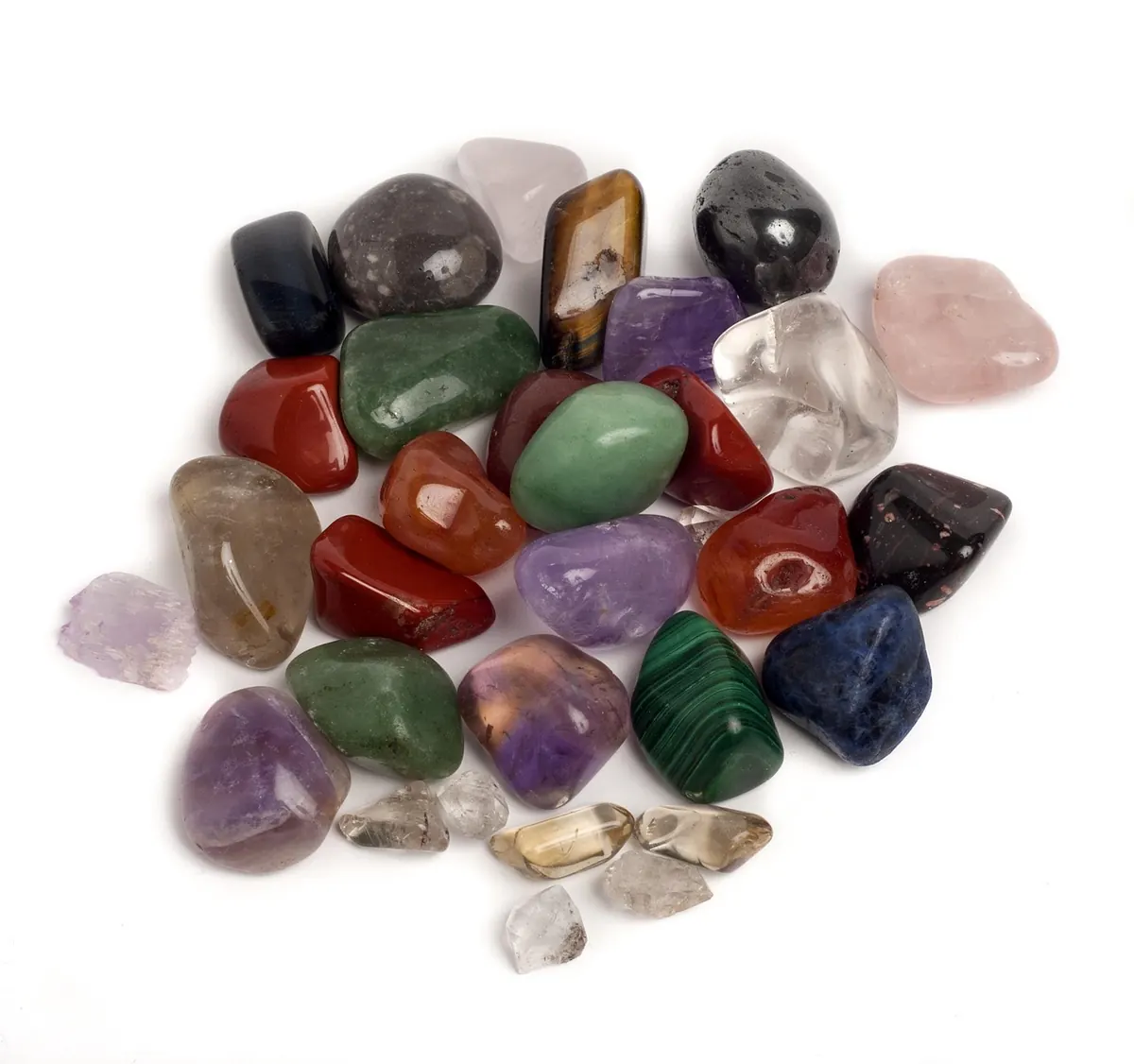
Walk into any crystal shop and the labels start to blur: points, clusters, tumbles, and a dozen variations of "quartz" in five shades of pink and brown. Most of what a beginner sees on the shelf comes down to four varieties — clear, rose, smoky, and amethyst. Each has its own look, its own common treatments, and a few honest questions worth asking before you spend money. This guide sticks to what you can check with your own eyes, plus a few practical habits that make comparison shopping easier.
What "Quartz" Actually Means
Quartz is silicon dioxide, one of the most abundant minerals in the earth's crust. That single fact explains a lot about the market: none of the stones in this guide are rare in the way a collector would use the word. Good pieces are plentiful, which means you can afford to be fussy.
For shopping purposes, quartz splits into two families. Macrocrystalline quartz forms crystals you can see — points, clusters, faceted stones. Microcrystalline quartz is the fine-grained group that includes agate, jasper, and chalcedony, which we'll leave for another time. Clear, rose, smoky, and amethyst are all macrocrystalline.
Pure quartz is colorless. Color arrives through trace elements and, in smoky quartz and amethyst, natural irradiation over long periods. That matters because heat and dye can imitate or intensify those colors cheaply, and the trade doesn't always say so on the label. When you look at a quartz label, you're really checking three things: the variety, the shape, and whether the color is natural or enhanced. The variety tells you what family you're in; the shape tells you how much labor is in the piece; the treatment question tells you how much you're paying for nature versus chemistry.
Clear Quartz: The Blank Canvas
Clear quartz is colorless, from water-clear to milky, and it takes almost any shape a seller wants to offer: single points, double-terminated crystals, clusters, spheres, tumbled stones, and faceted gems. It's the easiest variety to start with because there's no color to judge — only clarity, shape, and condition.
A single point may be polished or left with a rough base; a cluster may be sold by weight; a sphere may be priced for how well it catches light. None of these shapes is inherently better, but they're not interchangeable, either. A clean point with a good tip and a flat base is a different purchase from a tumbled stone that happens to be clear.
Inclusions are part of the character. Needles of rutile make rutilated quartz; green chlorite creates phantom layers that look like a tiny landscape trapped inside the stone; internal fractures throw rainbow flashes when you tilt the piece. Some buyers pay a premium for those rainbows, others see cracks. Neither view is wrong, but know which one you're holding before you pay extra.
Watch for glass
Perfectly clear, perfectly uniform quartz at a low price is often glass. Glass has no inclusions or growth lines, may contain tiny round bubbles, and feels warmer sooner than stone. Quartz sits at 7 on the Mohs hardness scale and glass around 5.5, so glass scratches more easily — but don't test that in a shop. Instead, look for small natural inconsistencies: faint growth lines, a slightly uneven polish, a thin veil of inclusions near the base.
What to look for in clear quartz
- Clarity: Decide whether you want water-clear, milky, or something in between. Both ends of the range can be beautiful, but they should be priced differently.
- Tip and base: A sharp, undamaged tip adds to the look of a point. A flat, stable base makes it easier to display.
- Rainbows: Internal fractures can flash color in the light. If you love that effect, enjoy it, but don't assume every crack is a bonus.
- Consistency: Natural quartz often has small variations. If a piece is perfectly uniform from every angle, ask what it is.
Rose Quartz: Soft Color, Cloudy Body
Rose quartz ranges from barely-there pink to a deeper rose, and it's almost always cloudy or milky rather than transparent. Most of it forms in massive veins, so you'll rarely see natural crystal points; shapes are usually tumbled, carved, or polished into spheres and hearts. A few pieces show a six-ray star when cut as a dome — star rose quartz — and those are priced accordingly.
The best pieces have a gentle glow rather than a flat coat of color, and you can usually see a little cloudiness or soft veining under the surface. That cloudiness is part of the stone's character, not a flaw to bargain away.
Because the color is gentle, rose quartz is one of the most dyed stones in the beginner market. Dye shows up as a hot, uniform pink that looks slightly unnatural, and it collects in cracks and around drill holes. Wipe an inconspicuous spot with a damp white tissue; if pink comes off, you have your answer. Natural rose quartz has a soft, uneven tone and a cloudy body you can see into. If a rose quartz heart is the same pink as a candy wrapper and the price is unusually low, slow down.
One practical note: rose quartz can fade with long exposure to strong sunlight. If you keep a piece on a bright windowsill, rotate it or move it back a little.
Star rose quartz and other variations
Star rose quartz is cut as a smooth dome so that light reflects in a six-ray star across the surface. It's less common than ordinary rose quartz and should cost more. Deeper pink material from some sources is also sold at a premium, but color alone isn't a guarantee of quality. Look for a soft, even glow, a clean polish, and a star that shows clearly in direct light.
Smoky Quartz: Bronze to Near-Black
Smoky quartz runs from pale champagne through warm brown to a dark brown so deep it reads almost black — that darkest grade is sometimes called morion. Hold a piece up to the light: good smoky quartz has depth and transparency, not a flat, muddy surface. A pale champagne point can be lovely in a small piece, while a near-black morion needs good lighting to show its transparency.
Natural color often looks uneven. You may see color concentrated toward the tip, faint zoning, or smoky wisps that fade into clearer quartz. Much of the very dark, very uniform material in the trade has been irradiated to deepen the color. This is common and widely accepted, but a seller should be willing to say so when asked. If they don't know, that tells you something about the stock.
Smoky quartz is also easily confused with smoky citrine, which is heat-treated amethyst and usually shows a brownish-yellow tone rather than true brown. If a piece looks brown at the base and yellow at the tip, ask what it started as.
Dark does not always mean better
A very dark smoky quartz can be dramatic, but darkness can also hide internal flaws. Hold the piece up to a lamp or phone light. If it stays opaque and flat, you're paying for size rather than clarity. A slightly lighter stone with visible depth and a clean polish is often the better buy.
Amethyst: Purple, With a Few Catches
Amethyst is the purple variety of quartz, colored by iron impurities and natural irradiation. It ranges from pale lavender to deep violet, and it's one of the few quartz varieties that regularly appears as both rough clusters and faceted gemstones. Good amethyst has life in the color: it shifts as you turn it, with flashes of red or blue at the edges rather than a flat purple paint.
Natural amethyst often shows uneven color, with darker tips or bands of white quartz. That's normal, not a defect. In fact, strong zoning can be a reassuring sign that the stone grew naturally. The trade also heat-treats amethyst to produce citrine, and it can be irradiated or dyed to deepen color. Synthetic amethyst is sold too, often as very clean, very uniform faceted stones at low prices. If a large faceted amethyst is flawless, intensely purple, and surprisingly cheap, ask about its origin and treatment.
Amethyst comes as geodes, clusters, points, tumbled stones, and faceted gems. Chevron amethyst shows V-shaped bands of purple and white; ametrine combines purple and yellow in one stone. Some ametrine is natural, some is treated, so the label matters. Pale amethyst can fade with long exposure to strong sunlight, so keep a favorite piece out of direct sun if the color is important to you.
A Beginner’s Buying Checklist
Before you buy, run through the same short list. It won't turn you into a gemologist, but it will keep you from paying for a story you can't verify.
- Decide the job first. A tumbled stone for a pocket, a point for a shelf, and a faceted stone for jewelry are different purchases. Don't compare them by price alone.
- Bring a small light. A phone light shows inclusions, color zoning, and whether a dark stone has any transparency.
- Check color in neutral light. Shop lighting can make pink look rosier and purple look deeper. Step toward a window if you can.
- Look for natural clues. Growth lines, uneven color, and small inclusions are not flaws by default. Perfect uniformity is the thing that deserves a second look.
- Ask about treatments. Heat treatment, irradiation, and dye are common in the quartz trade. A good seller should be able to answer plainly.
- Compare by size and weight. Two pieces with the same price tag may not be the same value. Check the dimensions or ask for the weight.
- Buy the piece, not the story. A nice stone should stand on its own appearance and condition. Claims you can't check are not a reason to pay more.
Care and Cleaning Basics
Quartz is durable, but it isn't indestructible. A little care keeps a favorite piece looking the way it did in the shop.
- Dust often. A soft cloth is usually enough. Dust dulls the polish and hides the clarity you paid for.
- Wash with lukewarm water and mild soap. Rinse well and dry with a soft cloth. Avoid sudden temperature changes, which can stress internal fractures.
- Skip harsh cleaners. Household chemicals, bleach, and abrasive powders can damage the surface or dull a polish over time.
- Be careful with dyed or fractured pieces. Dye can leach, and cracks can trap soap or water. Keep cleaning simple.
- Store separately. Quartz is harder than many other stones and can scratch them. Wrap pieces or keep them in separate compartments.
- Watch the sun. Rose quartz and pale amethyst can fade with long exposure to strong sunlight. Rotate display pieces or move them out of direct sun.
None of this is complicated. The main skill is slowing down: look at the stone in good light, ask one or two direct questions, and compare a few pieces before you choose. Clear, rose, smoky, and amethyst are all common enough that you can afford to wait for one that looks right to you.
If a piece is too perfect, too uniform, and too cheap, ask one more question before you pay.
Photo: marsjo / Pixabay